.post-body img, .entry-content img { max-width: 100% !important; height: auto !important; }

Search this Blog

Showing posts with label Chemistry. Show all posts

Friedrich Bergius: The Bergius Process


Friedrich Bergius, German chemist known for Bergius Process


Friedrich Karl Rudolf Bergius (Oct 11, 1884 – March 30, 1949), was born in Goldschmieden near Breslau (Wroclaw), within the German Empire's Prussian Province of Silesia. He was a German chemist known for the Bergius process that produces synthetic fuel from coal. His discovery converted wood into sugar, and coal into petrol products.

He was educated at the universities of Breslau, Berlin and Leipzig.  His book which was published in 1913, The Use of High Pressure in Chemical Actions, explains his work.

Melvin Calvin: Calvin Cycle and Photosynthesis


American chemist famous for Calvin Cycle discovery and photosynthesis


Melvin Ellis Calvin (April 8, 1911 – January 8, 1997), was an American chemist famous for his work on photosynthesis and discovering the Calvin cycle along with Andrew Benson and James Bassham. He contributed in all areas of Chemistry and  spent most of his career at the University of California, Berkeley. He was awarded the 1961 Nobel Prize in Chemistry.

M. Calvin Brief Profile

The son of Russian and Lithuanian immigrants to the U.S., Melvin Calvin was born in St. Paul, Minnesota. The family settled in Detroit, Michigan, where he attended the Michigan College of Mining and Technology, becoming the school's first chemistry major. He completed his Ph.D. in Chemistry from the University of Minnesota.  He also studied at the University of Manchester and University of California, Berkeley.

It was in the early 1940s when Calvin began to focus his work on photosynthesis by using radioactive tracers in chemical reactions. During this period in his researches and experiments, his now known Calvin Cycle of plant photosynthesis took fruition.

The Calvin Cycle and Photosynthesis

The Calvin Cycle or the Calvin-Benson-Bassham Cycle - is a system that describes the series of biochemical reactions taking place in the chloroplasts of photosynthetic organisms.  Further, the cycle describes a light independent reaction (that is, without any need for visible or ultraviolet light), where stored energy is used to convert carbon dioxide and water into organic compounds.  In each stage of the process of  "carbon fixation," carbon dioxide is added with a carbon-14 tracer to explain the chemical pathway.


Resource:


"Melvin Calvin - Biography". Nobelprize.org. 9 Apr 2012.


Image Source:

Melvin Calvin, Nobelprize.org.

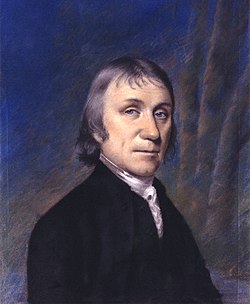
Joseph Priestley and Oxygen


British chemist and clergyman, chemistry of gases pioneer

Quarter-length portrait of a man in a black coat against a purple and blue curtain backdrop.
Joseph Priestley (1733-1804), English clergyman and chemist, one of the discoverers of oxygen, was born on March 13, 1733, in Fieldhead, Leeds. He spent four years at a dissenting academy in Daventry and later became a minister at Needham Market.

Priestley wrote The Scripture Doctrine of Remission, Letters to a Philosophical Unbeliever, and his controversial History of Early Opinions Concerning Jesus Christ (1786.) In 1761, he became a teacher at Warrington Academy. It was during his visits to London that he met Benjamin Franklin who supplied him with books for his History of Electricity published in 1767.

Otto Hahn: Nuclear Fission

Science Datebook: March 8

Otto Hahn discovered nuclear fission


Otto Hahn (1879-1968), German radio chemist and Nobel Prize winner, is born on March 8, 1879, in Frankfurt, Germany, and died July 28, 1968, in Gottingen, Germany. He discovered nuclear fission, in particular, the split of uranium atom into barium and krypton.

Hahn was awarded the 1944 Nobel Prize in chemistry, and shared the 1966 Enrico Fermi Award. He was involved in the discovery of several new radio elements, among them radiothorium, radioactinium and mesothorioum.

Max Ferdinand Perutz

Scientist Datebook:  May 19

Biochemist awarded the 1962 Chemistry Nobel prize for his studies in the structures of haemoglobin and globular proteins.


Max Ferdinand Perutz, FRS, OM, CBE (b. May 19, 1914, Vienna, Austria – d. February 6, 2002, Cambridge, United Kingdom) was an Austrian-born British molecular biologist. Both his parents, Hugo Perutz and Dely Goldschmidt, came from families of textile manufacturers who had made their fortune in the 19th century by the introduction of mechanical spinning and weaving into the Austrian monarchy.

Perutz shared the 1962 Nobel Prize for Chemistry with John Kendrew, for their studies of the structures of hemoglobin and globular proteins.

Chemical Bonding

The discovery of Chemical Bonding is linked to two scientists, Linus Pauling and Robert Mulliken.


The significance of the chemical bonding as a discovery is that it demonstrated how the new physics of quantum mechanics could explain the basis and fundamentals of a chemical interaction.


In the early 20th century, the nature of the atom has been developed and explained by chemistry and physics. However, in terms of quantum mechanics, these two science disciplines provided different perspectives. One point of contention was the chemical bonding of the element carbon. Whilst physicists and chemists agree on carbon's structure, that is, 6 electrons, 2 in an inner shell and 4 in an outer shell, its bonding issue in terms of the outer reaction of the 4 electrons was more complicated than normally met the eye of the chemists and physicists.

Lars Onsager


Science / Scientist Datebook


Lars Onsager, Norwegian Chemist and Physicist

Credited for his discovery of the Onsager reciprocal relations, fundamental for the irreversible processes of thermodynamics.


Lars Onsager (November 27, 1903 – October 5, 1976) was a Norwegian-born American physical chemist and theoretical physicist, winner of the 1968 Nobel Prize in Chemistry. He held the Gibbs Professorship of Theoretical Chemistry at Yale University.

His research at Brown University was concerned mainly with the effects on diffusion of temperature gradients, and produced the Onsager reciprocal relations, a set of equations published in 1929. Two years later its form was expanded in statistical mechanics whose importance went unrecognized for many years. Their value became apparent during the decades following World War II. By 1968 they were considered important enough to gain him that year's Nobel Prize in Chemistry.

The Chemistry of Planet Earth


Earth Chemistry for Earth Day


Our Earth is the only planet that can initiate and sustain life-forms, with an atmosphere containing two chemical elements, 78% of nitrogen and 21% of oxygen at an average temperature of 15 degrees Celsius and with two-thirds of its surface covered by ocean. 

A chemical element is a basic substance found in nature. It cannot be broken down into simpler substances by using ordinary chemical processes. The elements are the building blocks for all other substances. When they are combined with other elements the result is called a compound. For example, water is a chemical compound of the elements oxygen and hydrogen.

Nature has 92 chemical elements, and more than 20 additional ones have been created artificially in laboratories. Some elements, including nitrogen – the major component of air – are present in great abundance. Some are quite rare.

Marie Skłodowska Curie


Science / Scientist's Datebook: November 7
 

Polish-French Chemist and Physicist, famous for pioneering work on Radioactivity    


Marie Curie 
 
Marie SkÅ‚odowska Curie (7 November 1867 – 4 July 1934), was born in Warsaw, Poland. She was a chemist and physicist famous for her pioneering work on radioactivity. Although her work brought about her death, it led to the discovery of cancer treatments, saving countless lives.

Marie Curie was married to a fellow scientist, Pierre Curie, and mother of Irène Joliot-Curie and Ève Curie. Despite being barred from higher education due to her sex, Curie pursued her studies at the clandestine "Flying University," where she laid the foundation for her revolutionary discoveries of radium, polonium, and the concept of radioactivity.

Irene followed in her parents' footsteps also becoming a Nobel laureate in Chemistry (1935) with her husband Frédéric Joliot-Curie. Eve (Ève Denise Curie Labouisse) was a writer, journalist and pianist. Ève was the only member of her family who did not choose a career as a scientist, however, her husband Henry Richardson Labouisse, Jr., American diplomat and statesman, collected the Nobel Peace Prize in 1965 on behalf of UNICEF.

Otto Heinrich Warburg

Science / Scientist Datebook: October 8


Biochemist, Medical Doctor, and Nobel Laureate


Otto Heinrich Warburg (October 8, 1883 – August 1, 1970), a German physiologist, medical doctor and Nobel laureate, was the son of physicist Emil Warburg.  One of the 20th century's leading biochemists, his combined work in plant physiology, cell metabolism and oncology made him an integral figure in the later development of systems biology. He also worked with Dean Burk in photosynthesis to discover the I-quantum reaction that splits the carbon dioxide (CO2), activated by the respiration.

He won the Nobel Prize of 1931. An officer in the elite Ulan (cavalry regiment) during the First World War, he won the Iron Cross (1st Class) for bravery.

Jean S. Stas

Scientist Datebook:  August 21

Belgian Analytical Chemist


Jean Servais Stas was born August 21, 1813. He is known for his accurate determination of atomic weights, a most skillful chemical analyst of the 19th century.

Stas was born in Leuven. Initially, he trained as a physician but later changed to chemistry and worked at the Polytechnic School in Paris under Jean-Baptiste Dumas. The two of them setup the atomic weight of carbon by weighing a sample of the pure material, burned it in pure oxygen, then weighed the carbon dioxide produced.

Robert Burns Woodward

Known for his synthesis of complex organic substances, including cholesterol and vitamin B12.
 

Robert Burns Woodward (April 10, 1917 - July 8, 1979), was an American chemist born in Boston, Massachusetts, the son of an English father and Scottish mother.

He became professor Harvard and was a Nobel laureate in Chemistry, awarded a Nobel Prize in 1965 in recognition of his synthesis of a number of complex organic substances including cholesterol, cortisone, strychnine, reserpine, chlorophyll, lysergic acid, and some others.

Robert Woodward worked closely with Roald Hoffman on theoretical studies of chemical reactions. His contributions are significant especially in the area of organic chemistry.


Resource: 

"Robert B. Woodward - Biographical". Nobelprize.org. Nobel Media AB 2014. Web. 12 Apr 2016.

Louis Pasteur and the Pasteur Effect

Science / Chemistry & Microbiology

French Chemist and Microbiologist who pioneered the theory that germs cause disease. He is known for Pasteur Effect.

Louis Pasteur (December 27, 1822 – September 28, 1895) was born in Dole, France. He came from a family of tanners. As a child, it was apparent to his teachers that he was academically inclined. He was also a keen artist.

At 21, Pasteur was admitted to the fine Parisian training college, the École Normale Supérieure. He became a master of science in 1845. Two years later, he presented a thesis on crystallography earning him a doctorate.

His prestigious academic background and ground-breaking research into physical chemistry immediately gained him a professorship in the science faculty at the University of Strasbourg where he met his future wife, Marie Laurent, the daughter of the university rector. They were married in 1849 and had five children.

Edison, Nobel, and Leonardo da Vinci

3 Great Inventors: Thomas Alva Edison, Alfred Nobel, and Leonardo Da Vinci


Through time, inventors and innovators have seized opportunities at the expense of their personal lives to create what the world is benefiting now. Often, these men and women are so capable of innovative thoughts that they don’t make just one contribution to the world but many.

Thomas A. Edison (1847-1931)


American inventor who invented the light bulb and motion pictures among many of his patents. He is considered the most productive inventor in his day, receiving over 1,000 patents for practical applications pertaining to scientific principles. Aside from all his numerous inventions, Edison discovered the Edison Effect in 1883, which later formed the basis of the electron tube. Six years later, in 1889, he formed the Edison Electric Light Company, which through mergers General electric (GE), in 1892.

Alfred Bernhard Nobel (1833-1896)


Swedisth chemist, industrialist and engineer. He is famous for his invention of the explosive or dynamite, a more powerful form of blasting gelatin, and Nobel Prize awards. Nobel also produced ballistite, one of the first nitroglycerin smokeless powders. His immense fortune acquired from the manufacture of explosives and other interests he bequeathed to establish the prestigious Nobel Prizes, first awarded in 1901.

Leonardo da Vinci (1452-1519)


Florentine painter, sculptor, architect, scientist, and engineer. He is regarded the "Renaissance Man" himself, most famous for Mona Lisa, The Last Supper, and St. Anne with the Madonna and Child painting, among others. And of course his sketches and priceless ideas in his notebook. He founder the Classic style of painting of the High Renaissance, and among the first to use the chiaroscuro technique. In 1482, Leonardo da Vinci moved to Milan to become civil and military engineer to Duke Lodovico Sforza, where he painted "Madonna of the rocks," and numerous other works, including the "Last Supper."

Chocolates! From Cacao Beans to Candy Bars: How Chocolate is Made

Science / Discoveries

Hundreds of years ago, the ancient Aztecs, who ruled Mexico until the 1500s, were drinking chocolate. They made a spicy drink called xocoatl from cacao beans or seeds, which translates to “warm and bitter liquid” or “bitter water.” Then xocoatl became xocolatl in the Nahuatl dialects of Mexico.  In effect, xocolatl is the link to the modern word, chocolate.

How was Xocolatl Discovered?

 Cacao Beans

In 1502, the Spanish explorer Christopher Columbus met some Aztec people in the West Indies. They gave him cacao beans as payment for trading goods. Columbus didn’t like the spicy drink they made from the beans, and didn’t realize how important cacao beans would become.

In 1519, another Spanish explorer, Hernán Cortés, met Moctezuma, an Aztec emperor who loved xocolatl. Cortés realized how valuable the beans were and brought the drink back to Spain.

The Beginning of Hot Chocolate


When Cortés introduced xocolatl to the Spanish people, it was still a bitter-tasting drink. People experimented by adding different ingredients. Eventually, someone tried adding sugar, and sweet hot chocolate was born.

In the 1500s and 1600s, cacao and sugar were very expensive, and only the rich could afford to drink chocolate. For instance, in France, only members of the royal court were permitted to drink hot chocolate.

From Hot Chocolate to Candy Bars


What Americans generally call  “candy bars” is referred to as “chocolate bars” in British and Commonwealth countries like Australia, New Zealand, Canada and South Africa. These are bars of solid chocolate that were first developed in the late 1700s.

In France and Italy a small scale production began after the Spaniards returned from South America with the recipe. At that time, the drink was prepared from  roasted crushed cocoa beans.
From Cailler (1819) to Lindt (1879), significant names in the development of chocolate are worth mentioning:
  • 1819  François-Louis Cailler, a 23 year-old Swiss who made the first bars of chocolate at Vevey.
  • 1826  Fry’s of England, were producing “chocolate lozenges” for medicinal purposes.
  • 1842  John Cadbury (founder of Cadbury and father of George Cadbury), of Birmingham, started to sell “French eating chocolate.”
  • 1853  Fry’s introduced their chocolate cream stick.
  • 1866  The first box of chocolates was made by Cadbury’s
  • 1973  First milk chocolate was manufactured by Daniet Peter, Cailler’s son-in-law.
  • 1879  Rodolphe Lindt, a Swiss confectioner invented a machine that produced cacao seed paste into smooth, creamy chocolate bars. He also built a factory in Berne.
At the beginning, Lindt’s blocks of chocolate were hard with a bitter after-taste, and the chocolate remained heavy and thick despite being heated up. The machine he invented kneaded the chocolate, and Lindt also started the significant addition of cocoa butter. The chocolate that everybody loves today was born. In 1880,  Rodolphe Lindt patented his invention.


And for Mozart lovers like me, there's Mozartkugeln!  Or a local favourite, Australia's Haigh's dark  marzipan bars!


Welcome news to “chocaholics” everywhere is a scientific finding in recent years that a small amount of chocolate is actually good for you. In particular the dark chocolate, which contains chemical compounds called flavanols, that are important for healthy blood vessels. According to the International Journal of Medical Sciences, findings from scientists suggest that flavanols offer benefits to brain blood flow and improve cognitive health.

One final note: the scientific name of the cacao tree is Theobroma cacao, “theobroma” meaning food of the gods – a most appropriate description, as any lover of chocolate will agree.


Resources:

1.  Bayard V, Chamorro F, Motta J, Hollenberg NK. Does flavanol intake influence mortality from nitric oxide-dependent processes? Ischemic heart disease, stroke, diabetes mellitus, and cancer in Panama. International Journal of Medical Sciences. 2007;4:53-58.  Accessed May 12, 2011.
2.  Giscard d’Estaing, Valérie, Associate Editor. The Book of Inventions and Discoveries. London: MacDonald Queen Anne Press, 1990.
3.  Ireland, Kenneth. Who Invented, Discovered, Made the First..?. London: Ravette Books, 1988.

Note: This piece was originally published in Decoded Science, May 13, 2011. / Tel


(c) May 2011. Tel. Inspired Pen Web. All rights reserved.

Phoebus Levene on DNA and RNA

Science / Discovery Dateline: February 25

Phoebus Levene (1869-1940), Russian-American biochemist, spearheaded DNA and RNA in nucleic acid.


Phoebus (Aaron Theodor) Levene was born on February 25, 1869, in Sasar, Russia. He qualified in medicine in St Petersburg and emigrated to New York in 1892. His interest moved to chemistry, and later became the founder-member of the Rockefeller Institute in New York. He applied chemistry to biological problems.

The most important of his many biochemical studies is his pioneer research on the nucleic acids. Levene's work established the nature of the sugar component defining the two types of nucleic acids - the DNA and RNA - the elements in the maintenance of life.


(c) February 2011. Tel. Inspired Pen Web. All rights reserved.