Search this Blog

Showing posts with label Mozart in Films. Show all posts

Top 50 Greatest Biographical Movies (Biopics)


Films / Biographical Movies


A biopic, or a biographical movie, is a film that deals with the story of a well known person or group of people in history. Here's website containing a list of 50 films considered the greatest  biopics of all time as this time of posting.


1. Amadeus (1984)


The life, success and troubles of Wolfgang Amadeus Mozart, as told by Antonio Salieri, the contemporaneous composer who was insanely jealous of Mozart's talent and claimed to have murdered him. The story is set in Vienna, Austria, during the latter half of the 18th century, and is a fictionalized story of Wolfgang Amadeus Mozart from the time he left Salzburg, described by its writer as "fantasia on the theme of Mozart and Salieri". Mozart's music is heard extensively in the soundtrack of the film. Winner of 8 Academy Awaards (1984).

2. Gandhi (1982)

Gandhi's character is fully explained as a man of nonviolence. Through his patience, he is able to drive the British out of the subcontinent. And the stubborn nature of Jinnah and his commitment towards Pakistan is portrayed.

3. Lawrence of Arabia (1962)

The story of T.E. Lawrence, the English officer who successfully united and led the diverse, often warring, Arab tribes during World War I in order to fight the Turks.

4. Malcolm X (1992)

Biographical epic of the controversial and influential Black Nationalist leader, from his early life and career as a small-time gangster, to his ministry as a member of the Nation of Islam.

5. Schindler's List (1993)

In German-occupied Poland during World War II, industrialist Oskar Schindler gradually becomes concerned for his Jewish workforce after witnessing their persecution by the Nazis.

Mozart's Sister Film by Rene Feret

Film / Mozart's Sister

Wolfgang Amadeus Mozart had an older sister, Maria Anna Mozart, "Nannerl" to her family.  Mozart’s Sister is a film accounting of her early life and the reasons why she abandoned her own career as a musician, composer and singer; instead, devoting her life to supporting her brother as dictated by their father, Leopold.

Maria Anna "Nannerl" Mozart was three years older than her brother Wolfgang Amadeus who adored his sister.  Much has been written and told of the early life of child prodigy Wolfgang Amadeus. His elder sibling, Maria Anna, affectionately known to her family as "Nannerl," was a gifted musician, composer and singer in her own right.

Mozart Music in Movies (More!)


You think you don't know or are not familiar with Wolfgang Amadeus Mozart's music. Chances are you've been hearing them while watching a movie, TV, or DVD. This list includes movies with his music used in them.

Over Christmas break I decided to re-visit Ipcress File, a great British spy film starring Michael Caine, and enjoyed that it features Mozart music. The main character, secret agent Harry Palmer (Caine), a working class guy is depicted as clearly cultured in his love for music (he loves Mozart), food and women. I've almost forgotten it has Mozart music in it including the master's Le Nozze di Figaro's Overture being played. His music is also featured in Agatha Christie's Miss Marple, and the British TV series Midsomer Murders and Inspector Morse.  

List of Mozart's music in films


(This post is updated as later information becomes available.)

6 German Dances (("Sechs Deutsche Tanze") K509, No. 1-3-- Amadeus 

The Abduction from the Seraglio (Die Entführung aus dem Serail), Ich gehe, doch rate ich dir -- Guarding Tess
The Abduction from the Seraglio (Die Entführung aus dem Serail) Turkish Finale -- Amadeus

Mozart Piano Concerto No. 21 in C Major

Classical Music / Piano Concertos


Wolfgang A. Mozart's Concerto No.21 became enormously popular with second Movement - Andante - better known as "Elvira Madigan"


Wolfgang Amadeus Mozart's Piano Concerto No. 21 in C major, K. 467 was first performed this day on March 10, 1785, in Vienna, with no less than the composer himself as the soloist. Mozart was 29 years old. It was completed on March 9, 1785 by Mozart four weeks (other biographers say it's three weeks) after the completion of his tempestuous D-minor concerto, K. 466.

Piano Concerto No.21 in C Major (K.467) by Mozart premiered on March 10, 1785, with no other than the maestro himself the soloist.  He was 29 years old.  (Mozart photo by C. Vogel.)

The concerto has three movements:
  • I. Allegro maestoso
  • II. Andante in F major - "Elvira Madigan" (Famously nicknamed "Elvira Madigan" - featured in the 1967 Swedish film of the same title,  Elvira Madigan. The imagery used in the movie was of a lazy boat ride on a placid lake. Since the film, "Elvira Madigan" has been used as the unofficial name of Mozart's second movement from this piano concerto. This dream-like andante movement is such a lovely melody. In recent times, it has also been used in some other films. It was also used in Marcel Barceau's funeral.)
  • III. Allegro vivace assai

A handbill advert read as follows:

"On Thursday, March 10, 1785, Kapellmeister Mozart will have the honor of giving in the Imperial and Royal Court Theater a Grand Musical Concert for his own benefit including not only a new, just finished fortepiano concerto [presumably sight-read by the orchestra] to be played by him, but also an especially large fortepiano with pedals will be used for improvisations. The remaining pieces will be announced by a large poster on the day of the concert."
 
 
Mozart: Piano Concerto No. 21 - Netherlands Philharmonic Orchestra, Ronald Brautigam - Live HD


Mozart - Piano Concerto No.21 "Elvira Madigan" - 2nd Movement - Andante

(Note: This is a slower version of Mozart's Piano Concerto 21 "Andante")


Wolfgang Amadeus Mozart's Piano Concerto No. 21 (Andante)


Resources:
  • Hutchings, A. 1997. A Companion to Mozart's Piano Concertos, Oxford University Press
  • Latham, Alison, ed., The Oxford Companion to Music. Oxford University Press ( 2002)
  • "Piano Concerto No. 21 in C, K. 467" written by Herbert Glass for the LA Times. www.laphil.com/philpedia/piece-detail.cfm?id=114&bc=1. Retrieved March 10, 2012.
  • Steinberg, Michael, The Concerto: A Listener's Guide, p. 305-307, Oxford University Press (1998)


Video Credit:
Mozart photos:  Public Domain.


(c) January 2010. Updated November 21, 2023. Tel. Inspired Pen Web. All rights reserved.

Mozart Music in Movies and TV (Earlier Post)


Films featuring the music of Wolfgang Amadeus Mozart


The list of Mozart music in films shared here is not exhaustive. Our aim is to impart awareness especially of those music you've heard unaware it's Mozart's.  The popular "Eine Kleine Nachtmusik" appears in more than one film, so does Clarinet Concerto, an all-time favourite.


Adagio of Gran Partita, Piano Concerto No. 20 (2nd movement), Requiem, and 1st movement of both Symphonies Nos. 25 and 29.

After Peter Shaffer's 1984 film Amadeus, directed by Milos Forman, many people who aren't into classical music "turned on" to Mozart. To Mozartians and Mozart admirers, the general initial reaction about the movie was one of disgust since it was not historically accurate, but that's Hollywood. On the other hand, the good side is that some people who didn't know much about him were so taken by Amadeus the film enough to pursue more information about this child prodigy and his music. Mozart's music in the film Amadeus include Adagio of Gran Partita, Piano Concerto No. 20 (2nd movement), Requiem, and 1st movement of both Symphonies Nos. 25 and 29.

Here's a great website to the various music in the film, Amadeus. 

Film:  Amadeus

Mozart film in Spanish - YouTube - Nov 4, 2013


Mozart in Spanish

(Sorry I haven't researched on this sites. I'll share when I have information to offer.) 

A vida de Mozart (Filme, Parte 1)


http://www.youtube.com/watch?v=LwhKL-mrGfE&app=desktop

A vida de Mozart (Filme, Parte 2)


http://www.youtube.com/watch?v=02I6ozf2fck  -- 

A vida de Mozart (Filme, Parte 3, final)


http://www.youtube.com/watch?v=jfBVzkYyeCk


Mozart and 'Amadeus' the Movie

Film / 'Amadeus'


 Is Amadeus the film truthful about Mozart's life?


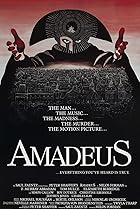
Amadeus the film is a fictionalized story of Wolfgang Amadeus Mozart from the time he left Salzburg, described by its writer as "fantasia on the theme of Mozart and Salieri". The story is set in Vienna, Austria, during the latter half of the 18th century. Mozart's music is heard extensively in the soundtrack of the film.
 
The 1984 film
Amadeus features a large ensemble cast centered on the fictionalized rivalry between composers Wolfgang Amadeus Mozart and Antonio Salieri. The primary characters are: 
  • Antonio Salieri (F. Murray Abraham): The court composer to Emperor Joseph II, whose jealousy of Mozart's genius fuels his obsession.
  • Wolfgang Amadeus Mozart (Tom Hulce): The childish, profane, yet undeniably brilliant musical genius.
  • Constanze Mozart (Elizabeth Berridge): Mozart’s practical and often frustrated wife.
  • Emperor Joseph II (Jeffrey Jones): The monarch of Austria, known for his phrase "too many notes".
  • Emanuel Schikaneder (Simon Callow): The producer of The Magic Flute and a friend to Mozart.
  • Leopold Mozart (Roy Dotrice): Wolfgang’s strict and demanding father.
  • Count Orsini-Rosenberg (Charles Kay): The arrogant director of the Imperial Opera.
  • Caterina Cavalieri (Christine Ebersole): A singer and Salieri's pupil, who is pursued by Mozart. 
 
It is 1781, the year Mozart left Salzburg for Vienna, and Antonio Salieri (Abraham) is the court composer to Emperor Joseph II (Jeffrey Jones). When Mozart (Oscar nominee Tom Hulce as Mozart, in Amadeus) arrives at court, Salieri is horrified to discover that the godlike musical gifts he desires have been bestowed on the impish, bawdy young Mozart. Engulfed by envy, he plots to destroy Mozart by any means. Perhaps, even murder. The mystery, and the  music remain.  
 
As a lifelong Mozartian, I say no, Amadeus the film is not truthful. It is not a true story, but a fictional drama based loosely on historical figures,imagining a deadly rivalry between Mozart and Salieri.  Most of the plot revolves around Salieri vs. Mozart, and from Mozart biographies written by prominent writers on Mozart the two didn't seem to have that kind of relationship in real life, just as there is no historical proof that Salieri actually killed Mozart, who died from an illness. In other words, the core premise that Salieri murdered Mozart out of jealousy is a myth popularized by Alexander Pushkin's 1830 play, while the film adds many dramatic flourishes, though it incorporates some real aspects of Mozart's life, like his wit and some vulgarity. 
 
 
Factual versus Fictional Elements:
 
The Rivalry: 
The intense, murderous jealousy depicted is largely invented for dramatic effect; in reality, Mozart and Salieri were professional competitors in Vienna, but not deadly enemies, and Salieri even praised Mozart. 
 
Mozart's Character: 
The film portrays him as immature, childlike, and vulgar, which exaggerates documented traits (like bathroom humor) into a caricature.
 
Salieri's Character: 
He was a successful court composer, not a failed one, and the idea that he confessed to murder in old age comes from Pushkin's play, not history. 
 
Mozart's Death:
The film's depiction of a mysterious, slow death orchestrated by Salieri is false; the cause of Mozart's actual death is really not known, with theories including rheumatic fever or infection, and the infamous mass burial was an imperial decree not widely followed in Vienna. 
 
However, Amadeus the film  is a brilliant piece that uses historical figures to explore themes of genius, mediocrity, and faith, rather than a historical biography.  (Refer to my resources.)   

Here's an interesting quote I found from one of my old journals, I apologise if I haven't the actual source written down. But I couldn't agree more with the thoughtful comment:    

"A primary issue in both stage and screen versions is Mozart's behavior: his cavorting with Constanze in a public room of a noble residence, his use of inappropriate language, his excessive drinking, his lack of respect for the emperor and archbishop, his public parody of Salieri, his high self-opinion, and his general insensitivity to propriety. That which took place in view of the Salzburg archbishop and the emperor would have resulted in banishment from court or worse. Even though protocol had been loosened during the reign of the "people's" emperor, it is almost unimaginable that anyone would tell Joseph II that something he said was "absurd." Again, the result would have meant that none of the Viennese operas would have been commissioned or composed and that no venue for them would have existed. Certainly, Mozart must have treated the emperor and his entourage with some special care. Mozart's drinking runs as a sub-theme throughout the plot in Amadeus. But in reality, it seems that he rarely drank to excess, though in his last year or two his drinking did appear to have increased..."

Despite its heavily fictionalized narrative, the 1984 Amadeus film is widely credited with a massive, worldwide resurgence in popularity for Wolfgang Amadeus Mozart and his music. While historians, and naturally, fellow-Mozartians worldwide often point out the inaccuracy of the central conflict between Mozart and Antonio Salieri, the film’s success served as a "gateway" to classical music for new worldwide admirers of Wolfgang Amadeus Mozart. 
 
This sumptuous period epic film is a gripping human drama, a glorious celebration of the music of Wolfgang Amadeus Mozart. Amadeus the film won eight Academy Awards (1984), including Best Picture, Best Actor (F. Murray Abraham) Director (Milos Forman) and Adapted Screenplay (Peter Shaffer, based on his Tony-winning play).


Suggested Links:

Amadeus Complete Soundtrack Music. Beautiful Music Librarian. Accessed February 9, 2016.   

Mozart and Salieri: Truths and Myths. A Musical Vision, website of Dr. Vincent DeLuise. January 27, 2021.

The Making of Amadeus - director's cut by Milos Forman. Youtube, uploaded by director's cut. Accessed February 18, 2019.

"What Amadeus (the film) Got Right" by Dr. Vincent de Luise. A Musical Vision. Accessed January 27, 2023.    


Photo Credit:  

Amadeus film poster. Wikipedia Commons.   


Video Credits:

Amadeus the film (1984) ... various clips. Youtube. Accessed February 27, 2018.

Amadeus (1984) Directed by Milos Forman. (Trailer) Youtube, uploaded by Avids / Network. Accessed February 9, 2023.  

That was Mozart - Amadeus. YouTube, uploaded by Lucky Jack. Accessed February 27, 2018.


Resources:

Amadeus (film). en.wikipedia.org 
 
Amadeus: Film by Forman (1984). Britannica online. 
 
Amadeus. IMDB


(c) February 2011. Updated February 9, 2023.  Tel. Inspired Pen Web. All rights reserved.