.post-body img, .entry-content img { max-width: 100% !important; height: auto !important; }

Search this Blog

Showing posts with label French Operas. Show all posts

Massenet Opera Werther

Classical Music / Operas  


Werther is an opera (drama lyrique) in four acts by French composer Jules Massenet to a French libretto by Édouard Blau, Paul Milliet and Georges Hartmann (who used the pseudonym Henri Grémont). It is loosely based on the German novel by Johann Wolfgang von Goethe: Die Leiden des jungen Werther (English: The Sorrows of Young Werther), which was based both on fact and on Goethe's own early life. It was first performed in Vienna (in German), on February 16, 1892.
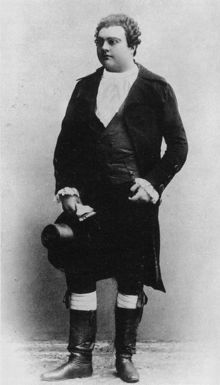
Ernest Van Dyck as Werther - NGO4p1142.jpg
The photo is that of Ernest van Dyck, the first singer in the title role, ca. 1892. 
 
In the video below, Antonio Pappano introduces the music of Massenet's Werther (The Royal Opera)


Suggested Listening:  
 
'Life and death on the stage': What makes Werther a masterpiece (The Royal Opera). Joyce DiDonato, Vittorio Grigòlo, Antonio Pappano and other members of the cast and creative team reveal why they think Massenet's Werther is an operatic masterpiece. Accessed February 16, 2023.
 
Massenet: Werther - Pourquoi me réveiller (Jonas Kaufmann). Werther - Jonas Kaufmann. Charlotte - Sophie Koch. Conductor / vezényel: Michel Plasson.  Opéra Bastille 2010. Uploaded by 70Tamas. Accessed February 16, 2023. 
 
Image Credit: 

Ernest van Dyck. en.wikipedia.org / Public Domain

Video Credit:  
 
Antonio Pappano introduces the music of Werther (The Royal Opera). YouTube, uploaded by Royal Opera House. Accessed February 16, 2023.


Resource: 

Werther. En.wikipedia.org.


(c) February 2018. Updated February 16, 2023. Tel. Inspired Pen Web. All rights reserved.

Bizet Opera Carmen

Classical Music / Opera
 
 
Opera synopsis, characters, and other information of Bizet's Carmen

The French opera Carmen by Georges Bizet is one of the most famous and loved operas of all-time. The libretto is written by Henry Meilhac and Ludovic Halévy, based on the novel by the same name, written by author Prosper Mérimée. Bizet found great opposition to the work, as many critics and the general public found the opera plot “indecent” during the time.

Carmen is first performed at the Opéra-Comique in Paris on March 3, 1875. For French opera, Carmen broke new dramatic ground as it moved away from opera buffa (comic opera), to a deeper tragic story. Sadly, composer Bizet did not live to see that his work was to become one of the most often performed operas in the world.

The 4-act opera setting takes place in Seville, Spain. The original opera production of Carmen had spoken dialog rather than recitative. After Bizet's death, his friend Ernest Guiraud replaced the dialog to a sung recitative.


Famous Arias from Carmen:
  • L'amour est un oiseau rebelle - Carmen
  • La fleur que tu m’avais jetée (The flower song) - Don José
  • Votre toast, je peux le rendre (Toreador song) - Escamillo

Apology: The video Originally featured is no longer available.  
Below is from Bizet's Opera Carmen - Bastille Opera. 


Berlioz Damnation of Faust Concert-Opera

Classical Music Milestone: December 6

Berlioz's La Damnation de Faust Premieres

This day, December 6 (1846), Hector Berlioz conducts the first performance of his French "opéra de concert," La Damnation de Faust (The Damnation of Faust), at the Opéra Comique, in Paris. Libretto is written by Hector Berlioz and Amire Gandonniere. It was based on G. de Nerval's adaptation of "Faust" by Johann Von Goethe. The Damnation of Faust (French: La damnation de Faust) , Op. 24, is a work for orchestra, four solo voices, and large children's chorus by French composer Hector Berlioz. He called it a dramatic legend (légende dramatique.)

It was not successful in its first performance, one reason was due to its being midway between opera and cantata. The composer was deeply hurt by the unsatisfactory critical acclaim and public indifference at the time. However, since its first successful complete performance in concert in Paris, 1877, La Damnation de Faust has been regularly performed in concert halls.

Rossini Opera The Siege of Corinthe

Classical Music Datebook:October 9


Rossini Opera Le Siège de Corinthe First Performed, 9 October 1826


Le siège de Corinthe (The Siege of Corinth) is Gioachino Rossini's first French opera. Is is in three acts to a French libretto by Luigi Balocchi and Alexandre Soumet, based on Maometto II by Cesare della Valle. It is also known in its Italian version as L'assedio di Corinto.


Opera History


Le Siège de Corinthe opera by Gioachino Rossini commemorates the siege and ultimate destruction of Missolongi town in 1826 by the Turkish during the ongoing Greek War of Independence (1821–1829). The reference to Corinth is an example of allegory, although Sultan Mehmed II had indeed besieged the city in the 1450s.


This same incident also inspired a prominent painting by Eugène Delacroix (Greece Expiring on the Ruins of Missolonghi), and was mentioned in the writings of Victor Hugo. He tried earlier versions but was not successful.

Offenbach Opera The Tales of Hoffmann

Le Contes d'Hoffmann, a French opera by Jacques Offenbach. The Tales of Hoffmann opera plot synopsis, character description, and other Offenbach opera information.

The Tales of Hoffmann (Les Contes d'Hoffmann) is a fantastic three-act opera composed by Jacques Offenbach (June 20, 1819 – October 5, 1880.) Libretto is written by Jules Barbier and Michel Carré based on E.T.A. Hoffmann stories. It was premiered at the Opéra Comique, Paris, on February 10th, 1881. The setting is in Nuremberg, Paris, Munich and Venice in the early 19th century.

Notable Arias: "Scintille diamante" (Dappertutto), "Elle a fui" (Antonia,) "Jour et nuit" (Franz,) and "Il était une fois à la cour d'Eisenbach" (Hoffmann.)