Search this Blog

Showing posts with label English Authors. Show all posts

William Somerset Maugham

Literature / Writers Datebook: January 25


Brief biography of the life and works of English writer William Somerset Maugham, known for his novels, plays and short stories. Famous for his novel Of Human Bondage.  


Early Years

William Somerset Maugham  (b. 25 January 1874 – d. 16 December 1965), was an English writer, known for his plays, novels and short stories. He was born in Paris, where he spent his first ten years, then schooled in England and went to a German university. In London he became a medical student and qualified as a physician in 1897 but he never practised medicine, instead, he became a full-time writer. 

His first novel, Liza of Lambeth (1897), a study of life in the slums, attracted attention, but it was as a playwright that he first achieved national celebrity. By 1908 he had four plays running at once in the West End of London. He wrote his 32nd and last play in 1933, after which he abandoned the theatre and concentrated on novels and short stories. 


Writings and Writing Style

Maugham's novels after Liza of Lambeth include Of Human Bondage (1915), The Moon and Sixpence (1919), The Painted Veil (1925), Cakes and Ale (1930) and The Razor's Edge (1944). His short stories were published in collections such as The Casuarina Tree (1926) and The Mixture as Before (1940); many of them have been adapted for radio, cinema and television. His great popularity and prodigious sales provoked adverse reactions from highbrow critics, many of whom sought to belittle him as merely competent. More recent assessments generally rank Of Human Bondage – a book with a large autobiographical element – as a masterpiece, and his short stories are widely held in high critical regard. Maugham indicates in his foreword that he derived the title from a passage in Baruch Spinoza's Ethics:  "The impotence of man to govern or restrain the emotions I call bondage, for a man who is under their control is not his own master ... so that he is often forced to follow the worse, although he see the better before him." Maugham's plain prose style became known for its lucidity, but his reliance on clichés attracted adverse critical comment. Maugham was among the most popular writers of his era and reputedly the highest-paid author during the 1930s.


First World War Years  

Maugham worked for the British Secret Service during the First World War. He later drew on his experiences for stories published in the 1920s. Although primarily homosexual, he attempted to conform to some extent with the norms of his day. After a three-year affair with Syrie Wellcome which produced their daughter, Liza, they married in 1917. The marriage lasted for twelve years, but before, during and after it, Maugham's principal partner was a younger man, Gerald Haxton. Together they made extended visits to Asia, the South Seas and other destinations. Maugham gathered material for his fiction wherever they went. They lived together in the French Riviera, where Maugham entertained lavishly. After Haxton's death in 1944, Alan Searle became Maugham's secretary-companion for the rest of the author's life. 

Maugham gave up writing novels shortly after the Second World War. He died at the age of 91.


Legacy

Although most of Maugham's early successes were as a playwright, it is for his novels and short stories that he has been best known. He was a prolific writer: between 1902 and 1933 he had 32 plays staged, and between 1897 and 1962 he published 19 novels, nine volumes of short stories, and non-fiction books covering travel, reminiscences, essays and extracts from his notebooks. William Somerset Maugham's works sold prodigiously throughout the English-speaking world.


Works by William Somerset Maugham

Liza of Lambeth  1897
Of Human Bondage  1915
Ours Betters  1917
The Moon and Sixpence  1919
The Circle  1921
The Trembling of a Leaf (including 'Rain')  1921
The Painted Veil  1925
The Constant Wife  1926
Cakes and Ale  1930
The Razor's Edge  1944


Image Credit:

W. Somerset Maugham. Wikipedia Commons. Public Domain. (Maugham by Carl Van Vechten, 1934)


Resources:

Great British Writers, Colour Library Books (1993)

Larousse Dictionary of Writers, edited by Rosemary Goring (1994)

Macmillan Dictionary of Women's Biography. 3rd Ed, ed. by Jennifer Uglow (1999) 

W. Somerset Maugham. en.wikipedia.org. 


(c) January 25, 2023. Tel. Inspired Pen Web. All rights reserved. 

Mary Wollstonecraft Godwin Shelley

 Literature / Writers Datebook: August 30


Brief biography of Mary Shelley, English horror writer, best known as the author of the novel Frankenstein


Early Life of Mary Shelley

Mary Wollstonecraft Godwin Shelley (b. August 30, 1797, London - d. February 1, 1851, London), was the daughter of William Godwin and Mary Wollstonecraft. Her father was a political writer and novelist who had revolutionary attitudes to most social institutions, including marriage. Her mother, also a famous writer, was one of the first feminists who died 11 days after Mary's birth. She was educated at home, where she met her father's literary friends.

Marital life with Poet Percy Bysshe Shelley 

In 1814, Mary began a romance with one of her father's political followers, the poet Percy Bysshe Shelley, who was already married. at the age of 16, Mary eloped with Shelley. Together with her stepsister, Claire Clairmont, she and Percy left for France and traveled through Europe. Upon their return to England, Mary was pregnant with Percy's child, a daughter. Over the next two years, she and Percy faced ostracism, constant debt and the death of their prematurely born daughter who eventually died in Venice. They married in late 1816, after the suicide of Percy Shelley's first wife, Harriet. They returned to England, where their son William was born. However, tragedy seemed never far away from their lives, for after their return to Italy, William died in 1819.      

Frankenstein, Mary Shelley's Masterpiece

Mary Shelley's first novel Frankenstein was published in 1818 when she was 21. In the style of the gloomy and sinister gothic novels, it deals with the ambitions of a young scientist to be the creator of life, the horrors that follow his experiment, and his destruction by the monster he creates. Frankenstein was immediately successful and has retained fascination, becoming the subject of many movies and plays.

Later Years

After her husband's death in 1822, Mary Shelley returned to England. Her second novel, Valperga, was published when she was 26. She also wrote accounts of her travels, verse, and few more novels, including one set in the future about the destruction of the human race, The Last Man. Recent scholars have shown increasing interest in her literary output, particularly in her novels, but none achieved the success of Frankenstein to this day. 


Works by Mary W. Godwin Shelley

History of a Six Weeks' Tour  1817

Frankenstein  1818

Valperga  1823

The Last Man  1823

The Fortunes of Perkin Warbeck  1830

Lodore  1835

Falkner 1837

Rambles in Germany and Italy 1844

The Journals of Mary Shelley (2 Vols)  1987 (Published after she died) 


Photo Credit: 

Mary Wollstonecraft Godwin Shelley.  Wikipedia Commons / Public Domain. (Richard Rothwell's portrait of Shelley was shown at the Royal Academy in 1840, accompanied by lines from Percy Shelley's poem The Revolt of Islam calling her a "child of love and light".)


Resources:

Goring, Rosemary, Ed. Larousse Dictionary of Writers. New York: Larousse, 1994

McGovern, Una, Ed. Chambers Biographical Dictionary. Edinburgh: Chambers Harrap Publishers, 2002

Ousby, Ian.  The Cambridge Guide to Literature in English. Cambridge: Cambridge University Press, 1993.

Uglow, Jennifer, Compiler & Editor, revised by Maggy Hendry. The Macmillan Dictionary of Women's Biography, 3rd Edition. London: Macmillan Publishers, 1999


(c) August, 2010. Tel. Inspired Pen Web. All rights reserved.

Daphne Du Maurier

Literature / Writers Datebook: May 13


Brief biography of Daphne Du Maurier, English novelist, short story writer and biographer, whose bestseller books are likewise blockbuster movies. She's famous of Rebecca, The Birds, Jamaica Inn, Frenchman's Creek, and My Cousin Rachel. 


 Daphne du Maurier was an English writer of romantic suspense novels, mostly set on the coast of Cornwall where she spent most of her life. She is best-known for her bestseller novels Rebecca, Jamaica Inn, Frenchman's Creek, and My Cousin Rachel, with all these novels becoming film blockbusters.


Du Maurier's Life in a Nutshell       

Daphne du Maurier was born in London on May 13, 1907. She came from an artistic family whose father was an actor-manager. Her grandfather was an artist and novelist.  She was married to Frederick Arthur Montague Browning, a lieutenant-general in the British Army.

In 1969, Du Maurier was made a Dame of the British Empire.  She died in Cornwall on April 19, 1989, at the age of 81.


Du Maurier's Bestseller Novels into Blockbuster Films

Her first novel, The Loving Spirit, was published when she was 24 years old. A string of other novels followed, some of them with historical settings.

Her most famous book is Rebecca, a gothic bestseller. The hero in the story is unable to forget his tragic first marriage while he tries to be happy with his second wife, Rebecca. It was made into a movie in 1940, starring Laurence Olivier and Joan Fontaine, and was voted the best picture of that year. It was directed by the famous Alfred Hitchcock, who also directed the 1963 film of du Maurier's frightening novel "The Birds" starring Tippi Hedren. It was Hedren's movie debut. 

Other bestsellers that were also made into motion pictures include Jamaica Inn, a tale of  smugglers, Frenchman's Creek, a pirate romance, and My Cousin Rachel, a sensational romance.


Other Writing Genres

Du Maurier also wrote biographies of members of her family and of Francis Bacon, an English statesman in the 1500s and 1600s. Her plays include September Tide. At age 70 she published her autobiography, Myself When Young.


Daphne Du Maurier Quote:

"We are all ghosts of yesterday, and the phantom of tomorrow awaits us alike in the sunshine or in shadow, dimly perceived at times, never entirely lost."

~ Growing Pains, Published in the USA as Myself When Young ~


Works by Daphne Du Maurier

The Loving Spirit, 1931

Jamaica Inn, 1936

Rebecca, 1938

Frenchman's Creek, 1941

Hungry Hills, 1943 

September Tide, 1948

My Cousin Rachel, 1951

Kiss Me Again, Stranger (including The Birds), 1952

The Scapegoat, 1957

Vanishing Cornwall, 1967

Myself When Young, 1977


Photo credit:

Daphne Du Maurier. NNDB / Public Domain


Resources:

Goring, Rosemary, Ed. Larousse Dictionary of Writers. New York: Larousse, 1994

Ousby, Ian.  The Cambridge Guide to Literature in English. Cambridge: Cambridge University Press, 1993.

Payne, Tom. The A-Z of Great Writers. London: Carlton, 1997


(c) May 2010. Tel. Inspired Pen Web. All rights reserved.  

Jane Austen

Literature / Writers Datebook: December 16


Brief biography of English writer Jane Austen, considered the first outstanding woman novelist. Best-known for her novels Pride and Prejudice and Emma. Her novels have been adapted to film and television series. 


 The commentary of English novelist Jane Austen bites and her masterful use of indirect discourse and irony makes her one of the most influential and respected novelists of the early 19th century.  Austen's stories are subtle as she tells about young, well-bred heroines, injecting the snobbery and the manners of their country-house families. In Pride and Prejudice, a young man and woman begin by disliking each other but at last fall in love. In Emma, a snobbish young woman develops into someone capable of feeling and love.

Early Life  

Jane Austen was born in Steventon, Hampshire, on December 16, 1775, one of two daughters of the Rev. George Austen and his wife Cassandra (née Leigh). Her brothers James and Henry followed in the path of their father and joined the clergy (the latter towards the end of his life after a successful career as a banker), while Francis and Charles both pursued naval careers.

Close Family Relationship

She had a sister, Cassandra, with whom she maintained a close relationship throughout her life. The abundant correspondence between the sisters provides historians with the greatest insight into Austen's past. The only undisputed portrait of Jane Austen is a  rudimentary coloured sketch done by Cassandra.  

Education

In 1783, she was educated briefly by a relative in Oxford, then in Southampton, and finally in 1785–1786, she attended the Reading Ladies boarding school in Reading, Berkshire. This uncommonly advanced level of education may have contributed to her early alignment towards writing, and she began her first novel in 1789. The Austen family also often enacted plays, which gave Jane an opportunity to present her stories.

Family Move to Bath

Austen's life was even less eventful than those of her characters. In 1801 the family moved to the socially esteemed spa city of Bath, which provides the setting for many of her novels. The following year, she received a marriage proposal from a wealthy man Harris Bigg-Wither, almost six years her junior. She refused him.

Move to Southampton

After the death of her father in 1805, Austen, her sister and her mother lived in Southampton with her brother Frank and his family for several years before moving to Chawton in 1809. Here her wealthy brother Edward had an estate with a cottage, where he allowed his mother and sisters to live. This home is now a museum and is a popular site for tourists and literary pilgrims alike.

Final Years  

It was in Chawton that she wrote her later novels. In 1816, she began to suffer from ill health and moved to Winchester to be closer to her doctor. It is now thought by some that she may have suffered from Addison's disease, a failure of the adrenal glands that was often caused by tuberculosis. At that time the disease was not known and unnamed. Her condition became increasingly unstable. She died aged 41, on July 18, 1817, and was buried in Winchester Cathedral.

Film Adaptation of Austen's Novels

Austen's novels have been adapted in a great number of film and television series, varying greatly in their faithfulness to the originals.

Pride and Prejudice has been the most reproduced of her works, with six films, the 2005 adaptation directed by Joe Wright, starring Keira Knightley (Elizabeth Bennett), Donald Sutherland (Mr. Bennett), Matthew Macfadyen (Mr. Darcy), and Dame Judi Dench (Lady Catherine de Bourgh), as well as the 2004 Hollywood adaptation Pride & Prejudice.

There is also a 1940 film version of the novel starring Laurence Oliver as Mr. Darcy, and Greer Garson as Elizabeth Bennett. Previously, there were five television series produced by the BBC, the most noteworthy being the well-loved 1995 version, starring Colin Firth and Jennifer Ehle.

Emma has been adapted on television several times, first in 1948. Recent versions include a 1972 British television version, the 1996 film Emma, with Gwyneth Paltrow and Jeremy Northam, and also in 1996 on British television with Kate Beckinsale.

Sense and Sensibility has been made into four films including the 1995 version, from a screenplay adapted by Emma Thompson (who won the Academy Award for Best Adapted Screenplay), directed by Ang Lee and starred Thompson and Kate Winslet.

Persuasion
has been adapted into two television series and one feature film. Mansfield Park and Northanger Abbey have also been made into films.  

Novels by Jane Austen

Sense and Sensibility, 1811

Pride and Prejudice, 1813

Mansfield Park, 1814

Emma, 1815

Northanger Abbey, 1817 (posthumous)

Persuasion, 1817 (posthumous) 

Love and Friendship, 1922 (posthumous)


Photo Credit:

 Jane Austen. Wikimedia Commons / Public Domain. (Portrait, c. 1810, in watercolour and pencil.)

Resources:

Cambridge Guide to Literature in English by Ian Ousby, Cambridge Univ. Press,  1993

Chambers Biographical Dictionary, edited by Una McGovern, Edinburgh. Chambers Harrap, 2002

Larousse Dictionary of Writers, edited by Rosemary Goring. New York: Larousse, 1994


(c) December 2009. Tel. Inspired Pen Web. All rights reserved.  

H.G. Wells

Literature / Writer's Datebook: September 21


Brief biography of H.G. Wells, English novelist, educator, and science-fiction writer, regarded as the father of modern science fiction.


Herbert George Wells or H.G. Wells, his nom de plume in the literary world, was born in Bromley, in the south of England, on September 21, 1866. His family was not wealthy, father unsuccessful as a tradesman. By winning a scholarship to a science school in London, he sealed a career as a shop assistant. He took first class honours degree in zoology.  His early life is reflected in many of his novels' protagonists, especially in terms of life struggles.

Training and Education

In college his tutor was Thomas Huxley, a scientist and teacher of comparative anatomy, who taught him about the famous Darwin's theory of evolution which states that animals evolve in response to changes in their environment. Darwin's idea fascinated him. H.G. Wells explored the idea in relation to the future of mankind in many of his novels.

Early Career: Bookkeeper, Teacher, and Journalist

Wells became a full-time writer when he was 29 years old, after an accident that damaged his kidneys. Prior, he worked as a bookkeeper, schoolteacher, and journalist.

Literary Career: Novelist and Science Fiction Writer

He wrote over 80 stories and novels. His literary career started with the publication of his novel novel The Time Machine. Some of these were science fiction, and some were novels about political and social ideas. Wells also wrote a popular history book, The Outline of History. His first novel, The Time Machine, is one of his best-loved works. It is about a time traveller who journeys to the future and witnesses the planet Earth die. He describes how, in the future, human beings have evolved into two species, the useless Eloi and the practical Morlocks. In another famous novel, The War of the Worlds, Wells describes how Martians invade the Earth and are only defeated by common human germs.

Family and Marital Life

His first marriage to a cousin Isabel was not a happy one, but her second marriage to Amy Robbins (he called 'Jane') lasted, although he had a liaison with another famous novelist Rebecca West for about ten years which attracted much attention. They had a son, Anthony West.   

Well's Beliefs and Leanings

Wells had great faith in the potential of science and technology to solve the problems of the human race. However, as he grew older, he began to feel that human beings have become too selfish and cruel in their use for technology. H.G. Wells was an advocate of the League of Nations and continued to see himself as an educator.  

H.G. Wells died at the age of 79, 13th of August, 1946.


Books by H.G. Wells

The Time Machine 1895

The Island of Dr. Moreau  1896

The Invisible Man  1897

The War of the Worlds  1898

When the Sleeper Awakes  1899

The First Men in the Moon  1901

The War in the Air  1908

The Outline if History  1920

The Shape of Things to Come  1933

The Holy Terror  1939


Image Credit:

H.G. Wells. Portrait by George Charles Beresford, 1920. Wikipedia Commons / Public Domain


Resources:

Cambridge Guide to Literature in English by Ian Ousby (1993)

H.G. Wells. en.wikipedia.org

Larousse Dictionary of Writers, edited by Rosemary Goring (1994)


(c) September 2009.  Tel. Inspired Pen Web. All rights reserved.   

Agatha Christie

Literature / Writer's Datebook: September 15


Brief biography of Dame Agatha Christie, English crime writer, creator of Belgian sleuth Poirot and elderly lady Miss Marple of St. Mary Mead.


Agatha Christie is considered the most famous of all crime writers. Her books have been translated in about 45 languages and continue to sell millions of copies worldwide. Many of them have been made into successful films and TV adaptations, among them are Murder on the Orient Express, Death on the Nile, And Then There Were None.

She is the queen of the 'whodunit' type of crime story in which the reader can puzzle out from train of clues which of the characters in the story is guilty of a murder. Her stories are known for their clever twists of plot.

Life of Agatha Christie in a Nutshell

Dame Agatha Christie was born Agatha May Clarissa Miller on September 15, 1890 in the southern coastal town of Torquay. She was privately educated at home then went on to study music in Paris. During World War I she worked as a nurse for the Red Cross. In 1914 she married Colonel Archibald Christie and had a daughter. The couple divorced in 1928. She then remarried to archaeologist Max Mallowan and accompanied him on many trips to Syria and Iraq. These travels gave her the setting for many of her novels.

Agatha Christie the Crime writer

Initially, she was a poet and author of children's books, until one day, challenged by her sister, in her late 20s. Aged 30, she produced her first book, The Mysterious Affair at Styles, which introduced the now famous Belgian detective Hercule Poirot. Subsequent crime novels followed.     

Christie came from an upper-middle-class background, the world she mainly wrote about in her books. Her writing style is simple and her ear for dialogue is brilliant. Her stories usually involve a murder that takes place among ordinary people. Among the two most memorable fictional characters are the impeccably clean and tidy Belgian sleuth, Hercule Poirot, and the quiet but inquisitive elderly, Miss Jane Marple. Detectives Tommy and Tuppence Beresford also feature in some of her books.

Christie also wrote plays. One of these, The Mousetrap, has been performed continuously at St Martin's Theatre, West Street, London since the 1950s. The play has become the longest running show in the history of British Theatre. In 1954, Agatha Christie won the New York Drama Critics' Circle Award, and in 1971 she was made a Dame. She died on January 12, 1976, aged 85.

Agatha Christie's Legacy

Christie wrote some 80 mystery novels, plays and short stories, and her novels have sold over two billion copies in 45 languages. Unlike many of her contemporaries, Christie's novels remain current as they were when first published. 

Among her plots, including And Then There Were None and Witness for the Prosecution,  contain ground-breaking twists that may have been copied but never duplicated. Murder on the Orient Express was made into a star-studded blockbuster film. For her contribution to British letters, Agatha Christie was named by HM Queen Elizabeth II, a Dame of the British Empire in 1971.

"The big houses have been sold, and the cottages have been changed and converted. And people just come – and all you know about them is what they say of themselves."

Agatha Christie, A Murder is Announced


Major Works by Agatha Christie

The Mysterious Affair at Styles, 1920

The Murder of Roger Ackroyd, 1926

Murder at the Vicarage, 1930

Murder on the Orient Express, 1934

Murder in Mesopotamia, 1936

Death on the Nile, 1937

Appointment with Death, 1938

And Then There Were None, 1941

They Do It with Mirrors, 1952

The Mousetrap, 1952

The Mirror Crack'd, 1962

A Caribbean Mystery, 1964

Endless Night, 1967

Curtain, 1975 


Image Credit:

Agatha Christie.  Wikimedia Commons / Free media repository. 


Resources:

Goring, Rosemary, Ed. Larousse Dictionary of Writers. New York: Larousse, 1994

McGovern, Una, Ed. Chambers Biographical Dictionary. Edinburgh: Chambers / Harrap Publishers, 2002

Ousby, Ian.  The Cambridge Guide to Literature in English. Cambridge: Cambridge University Press, 1993.

Payne, Tom. The A-Z of Great Writers. London: Carlton, 1997

Agatha Christie. en.wikipedia.org 


(c) September 2009. Tel. Inspired Pen Web. All rights reserved. 

D.H. Lawrence

Literature / Writer's Datebook: September 11


Brief biography of English novelist, poet, essayist and literary critic D.H. Lawrence, 20th century's most important authors. He wrote books with frankness in describing sexual relations that upset many people in his time.


David Herbert Lawrence, more popularly known as D.H. Lawrence, was one of 20th century's most prominent writers. He wrote books whose direct description of sexual relations upset many people, and made him a controversial author. 

Early Life

D.H. Lawrence was born in a Eastwood, Nottinghamshire, village in central England on September 11, 1885. His father was a coal miner and his mother a former schoolteacher. His parents were poor and quarrelled a lot. He was also often sick. His writing was encouraged by Ford Madox Ford and Edward Garnett.  

Career and Personal Life

Lawrence early years formed the basis for his first major work, Sons and Lovers, a semi-autobiography, which was published when he was 28. D.H. Lawrence trained to be a teacher at Nottingham University and later ran off with Frieda von Richthofen, wife of Ernest Weekley, the aristocratic German wife of a professor there. After her divorce, they married in 1914.

His next novel, The Rainbow, was seized by the police because it explored marital and sexual relations, used swear words, and talked openly about sex. The book is about two sisters growing up in the north of England. He was prosecuted for obscenity and left England and lived in Italy where he produced a sequel, Women in Love, which became a popular film starring Alan Bates, Oliver Reed and Glenda Jackson.

D.H. Lawrence and his wife Frieda travelled a lot, including in Australia, Italy and North America. They finally settled in Italy after he was told he was dying from tuberculosis. In Italy, he wrote his most controversial book Lady Chatterley's Lover. The book was first privately printed in Italy. It tells of the affair between a married wealthy woman and a man who works for his husband's estate. The book was made into a movie. It was only until 30 years after D.H. Lawrence's death that the uncut version of the book was published. Believed to be an obscene material, the publishers were accused, but later acquitted after a sensational trial.

D.H. Lawrence once again was further prosecuted for obscenity over the private publication of Lady's Chatterley's Lover in Florence in 1928. Opinion is divided over Lawrence's worth as a writer, but evidently he had strong effect on the younger intellectuals in his time, challenging them to interpret the human emotions on the higher level of consciousness. His last years were spent in Italy. He died March 2, 1930, at the age of 44, in Venice. 

Publications by D.H. Lawrence

1913 Sons and Lovers

1915 The Rainbow

1920 Women in Love

1920 The Lost Girl

1922 Aaron's Rod

1923 Kangaroo (reflecting a visit to Australia)

1923 Birds, Beasts, and Flowers

1923 Studies in Classic American Literature (Literary criticism)

1926 The Plumed Serpent (set in Mexico)

1927 Mornings in Mexico

1928 Lady Chatterley's Lover

1928 Collected Poems

1957 Complete Poems


Image credit:

D.H. Lawrence.  Public Domain. 

Resources:

Brief Biography of D.H. Lawrence. University of Nottingham.  Accessed September 11, 2018.

Cambridge Guide to Literature in English by Ian Ousby (1993)

D.H. Lawrence. en.wikipedia.org. 

Larousse Dictionary of Writers, edited by Rosemary Goring (!994)


(c) September 2009. Updated September 11, 2023. Tel. Inspired Pen Web. All rights reserved.
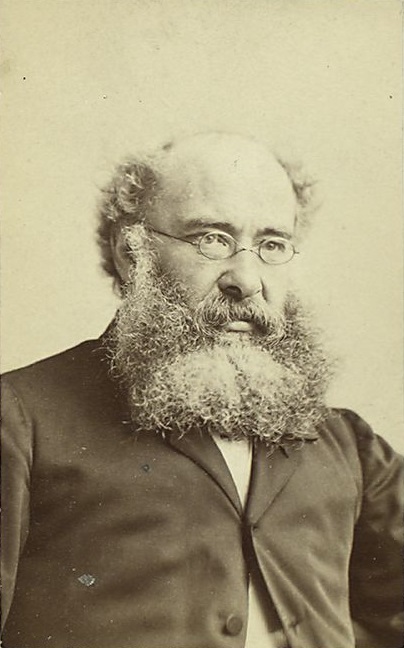
Anthony Trollope

Literature / Writers Datebook: April 24


Brief biography of Anthony Trollope, English novelist, a popular 19th century English novelist, best known as creator of stories set in the imaginary English county of Barsetshire and the aristocratic and political Palliser family. He delineated provincial English middle-class society in a series of novels set in fictitious cathedral city of Barchester. 


Early Life

Trollope was born in London on April 24, 1815,  and educated at Harrow and Winchester, two famous public schools. His mother, Frances Trollope, a prolific writer, earned money by writing novels and travel books. His father was an unsuccessful lawyer and Fellow of New College, Oxford.   

Early Career

At 19 Trollope became a post office clerk in London's General Post Office, and at 26 he was transferred in Ireland and made a deputy postal surveyor. He worked for the post office for 33 years. Notably, he first introduced the red British mail boxes known as pillar boxes. He left the civil service in 1867. He lived mainly in England and Ireland, but his work also took him to Africa and America.

Soon after marrying in 1844, Trollope began writing in his spare time to earn extra money. He regularly produced 1000 words an hour before breakfast. He was 32 when the Macdermots of Ballycloran, his first book, was published. His The Kellys and the O'Kellys were unsuccessful.

Later years as novelist

He was 40 when his first successful story The Warden, his first series of Barchester novels appeared. It is about a clergyman accused of misusing money meant for the old people's home he looks after. This series is about about people living in the imaginary cathedral city of Barchester. It includes the novels Barchester Towers (1857), Doctor Thorne (1858), and The Last Chronicle of Barset (1867).

The format of the Barchester series appealed to his readers and Trollope embarked on a more ambitious sequence, known as the Palliser novels.  Many of these later works are about power and politics involving his invented family of wealthy aristocrats and politicians called the Pallisers, with Plantagenet Palliser, as one of his lead characters. Among the novels in this second series are Can You Forgive Her? (1864) followed by Phineas Finn (1869); others in the sequence are The Eustace Diamonds (1873) and The Prime Minister (1876).

He wrote nearly 50 novels altogether. Trollope introduced into English fiction some of the most memorable characters like Mr. Harding, Archdeacon Grantly and Bishop Proudie. With humour and gentle satire, Trollope told stories of ordinary men and women with human weaknesses.

Trollope also wrote travel books, biographies of Thackeray and Cicero, among others; plays, short stories and literary sketches.  

Anthony Trollope died on December 6, 1882, in Marylebone, London. 


Photo Credit:

Anthony Trollope. Wikipedia Commons / Public Domain


Resources: 

Cambridge Guide to Literature in English by Ian Ousby (1993)
Larousse Dictionary of Writers, edited by Rosemary Goring (1994)
The A-Z of Writers by Tom Payne. Carlton Books Ltd. (1997)


(c) April 2008. Updated April 24, 2024. Tel. Inspired Pen Web. All rights reserved.