Search this Blog

Showing posts with label Nobel Laureates. Show all posts

John Bardeen

Science / Scientist Datebook: May 23 

Physicist and electrical engineer.  Nobel Laureate in Physics twice. 


John Bardeen (May 23, 1908 – January 30, 1991), was born in Madison,  Wisconsin. An electrical engineer and physicist, he was the only person to have won the Nobel Prize in Physics twice: first in 1956 with William Shockley and Walter Brattain, for their researches on semiconductors and their discovery of the transistor effect,  and in 1972 with Leon N Cooper and John Robert Schrieffer, for a fundamental theory of conventional superconductivity known as the BCS Theory. 

The transistor revolutionized the electronics industry, and made possible the development of almost every modern electronic device, from telephones to computers to missiles.

Friedrich Bergius: The Bergius Process


German chemist known for Bergius Process


Friedrich BergiusFriedrich Karl Rudolf Bergius (Oct 11, 1884 – March 30, 1949), was born in Goldschmieden near Breslau (Wroclaw), within the German Empire's Prussian Province of Silesia. He was a German chemist known for the Bergius process for producing synthetic fuel from coal. His discovery converted wood into sugar, and coal into petrol products.

He was educated at the universities of Breslau, Berlin and Leipzig.  His book which was published in 1913, The Use of High Pressure in Chemical Actions, explains his work.

Melvin Calvin: Calvin Cycle and Photosynthesis


American chemist famous for Calvin Cycle discovery and photosynthesis


Melvin Ellis Calvin (April 8, 1911 – January 8, 1997), was an American chemist famous for his work on photosynthesis and discovering the Calvin cycle along with Andrew Benson and James Bassham. He contributed in all areas of Chemistry and  spent most of his career at the University of California, Berkeley. He was awarded the 1961 Nobel Prize in Chemistry.

M. Calvin Brief Profile

The son of Russian and Lithuanian immigrants to the U.S., Melvin Calvin was born in St. Paul, Minnesota. The family settled in Detroit, Michigan, where he attended the Michigan College of Mining and Technology, becoming the school's first chemistry major. He completed his Ph.D. in Chemistry from the University of Minnesota.  He also studied at the University of Manchester and University of California, Berkeley.

It was in the early 1940s when Calvin began to focus his work on photosynthesis by using radioactive tracers in chemical reactions. During this period in his researches and experiments, his now known Calvin Cycle of plant photosynthesis took fruition.

The Calvin Cycle and Photosynthesis

The Calvin Cycle or the Calvin-Benson-Bassham Cycle - is a system that describes the series of biochemical reactions taking place in the chloroplasts of photosynthetic organisms.  Further, the cycle describes a light independent reaction (that is, without any need for visible or ultraviolet light), where stored energy is used to convert carbon dioxide and water into organic compounds.  In each stage of the process of  "carbon fixation," carbon dioxide is added with a carbon-14 tracer to explain the chemical pathway.


Resource:


"Melvin Calvin - Biography". Nobelprize.org. 9 Apr 2012.


Image Source:

Melvin Calvin, Nobelprize.org.

Ernest Rutherford: Nuclear Physics Pioneer

Science Datebook: March 11

Baron Ernest Rutherford, Father of Nuclear Physics


Baron Ernest Rutherford (b. August 30, 1871-d. October 19, 1937), was a New-Zealand born British physicist. 

This day on March 11, 1911, Ernest Rutherford is considered the father of nuclear physics, as he published his atomic theory describing the structure of the atom for the first time at the Manchester Literary and Philosophical Society.

He described the atom as having a central positive nucleus surrounded by negative orbiting electrons. His model suggested that most of the mass of the atom was contained in the small nucleus, with the rest of the atom mostly empty space. His conclusion followed what we now know as Rutherford's "gold foil experiment" especially amongst science students and other advocates.

Otto Hahn: Nuclear Fission

Science Datebook: March 8

Otto Hahn discovered nuclear fission


Otto Hahn (1879-1968), German radio chemist and Nobel Prize winner, is born on March 8, 1879, in Frankfurt, Germany, and died July 28, 1968, in Gottingen, Germany. He discovered nuclear fission, in particular, the split of uranium atom into barium and krypton.

Hahn was awarded the 1944 Nobel Prize in chemistry, and shared the 1966 Enrico Fermi Award. He was involved in the discovery of several new radio elements, among them radiothorium, radioactinium and mesothorioum.

Max Ferdinand Perutz

Scientist Datebook:  May 19

Biochemist awarded the 1962 Chemistry Nobel prize for his studies in the structures of haemoglobin and globular proteins.


Max Ferdinand Perutz, FRS, OM, CBE (b. May 19, 1914, Vienna, Austria – d. February 6, 2002, Cambridge, United Kingdom) was an Austrian-born British molecular biologist. Both his parents, Hugo Perutz and Dely Goldschmidt, came from families of textile manufacturers who had made their fortune in the 19th century by the introduction of mechanical spinning and weaving into the Austrian monarchy.

Perutz shared the 1962 Nobel Prize for Chemistry with John Kendrew, for their studies of the structures of hemoglobin and globular proteins.

Arthur Kornberg

Nobel laureate for DNA and RNA discoveries


Biochemist Arthur Kornberg specialized in molecular biology. His primary research interests were in biochemistry, especially enzyme chemistry, deoxyribonucleic acid synthesis (DNA replication) and studying the nucleic acids which control heredity in animals, plants, bacteria and viruses.

He was co-awarded the Nobel Prize in Physiology or Medicine 1959 for "discovery of the mechanisms in the biological synthesis of ribonucleic acid (RNA) and deoxyribonucleic acid together with Dr. Severo Ochoa of New York University.

Emilio Gino Segrè

Emilio Gino Segrè discovered technetium andastatine and antiproton


Emilio Gino Segrè (1 February 1905 – 22 April 1989) was an Italian physicist and Nobel laureate who discovered the elements technetium andastatine, and the antiproton, a sub-atomic antiparticle, for which he was co-awarded the 1959 Nobel Prize in Physics with American Owen Chamberlain. An Antiproton is an antiparticle that has the same mass as a proton but opposite in electrical charge.

He was born in Tivoli, near Rome, and studied engineering at the University of Rome La Sapienza before taking up physics in 1927. Segrè was appointed assistant professor of physics at the University of Rome in 1932 and worked there until 1936. He was Director of the Physics Laboratory at the University of Palermo from 1936 to 1938.

Lars Onsager


Science / Scientist Datebook


Lars Onsager, Norwegian Chemist and Physicist

Credited for his discovery of the Onsager reciprocal relations, fundamental for the irreversible processes of thermodynamics.


Lars Onsager (November 27, 1903 – October 5, 1976) was a Norwegian-born American physical chemist and theoretical physicist, winner of the 1968 Nobel Prize in Chemistry. He held the Gibbs Professorship of Theoretical Chemistry at Yale University.

His research at Brown University was concerned mainly with the effects on diffusion of temperature gradients, and produced the Onsager reciprocal relations, a set of equations published in 1929. Two years later its form was expanded in statistical mechanics whose importance went unrecognized for many years. Their value became apparent during the decades following World War II. By 1968 they were considered important enough to gain him that year's Nobel Prize in Chemistry.

Frédéric Joliot-Curie

Frédéric Joliot-Curie, French physicist, shared Nobel Prize in physics with wife Irène Joliot-Curie,  for artificial radioactivity.


Frédéric Joliot ( (19 March 1900 – 14 August 1958) was born in Paris and graduated from the Ã‰cole Supérieure de Physique et de Chimie Industrielles de la Ville de Paris.  In 1925 he became an assistant to Marie Curie at the Radium Institute. He fell in love with her daughter Irène Curie, and married in 1926. At the insistence of Marie,  Joliot-Curie obtained a second baccalauréat, a bachelor's degree, and a doctorate in science, doing his thesis on the electrochemistry of radio-elements.

Frédéric and Irène changed their surnames to Joliot-Curie after they married on October 4, 1926 in Paris, France. Eleven months later, their daughter Hélène, was born, who would also become a noted physicist. Their son, Pierre, born in 1932, was a biologist.  Frédéric Joliot-Curie devoted the last years of his life to the creation of a centre for nuclear physics at Orsay, where his children were educated.

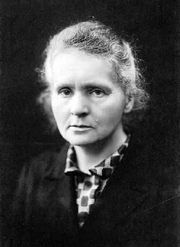
Marie Skłodowska Curie

Science / Scientist's Datebook: November 7
 

Polish-French Chemist and Physicist, famous for pioneering work on Radioactivity


Marie SkÅ‚odowska Curie (7 November 1867 – 4 July 1934), was born in Warsaw, Poland. She was a chemist and physicist famous for her pioneering work on radioactivity. Although her work brought about her death, it led to the discovery of cancer treatments, saving countless lives.

Marie Curie was married to a fellow scientist, Pierre Curie, and mother of Irène Joliot-Curie and Ève Curie. Despite being barred from higher education due to her sex, Curie pursued her studies at the clandestine "Flying University," where she laid the foundation for her revolutionary discoveries of radium, polonium, and the concept of radioactivity.

Irene followed in her parents' footsteps also becoming a Nobel laureate in Chemistry (1935) with her husband Frédéric Joliot-Curie. Eve (Ève Denise Curie Labouisse) was a writer, journalist and pianist. Ève was the only member of her family who did not choose a career as a scientist, however, her husband Henry Richardson Labouisse, Jr., American diplomat and statesman, collected the Nobel Peace Prize in 1965 on behalf of UNICEF.

Otto Heinrich Warburg

Science / Scientist Datebook: October 8


Biochemist, Medical Doctor, and Nobel Laureate


Otto Heinrich Warburg (October 8, 1883 – August 1, 1970), a German physiologist, medical doctor and Nobel laureate, was the son of physicist Emil Warburg.  One of the 20th century's leading biochemists, his combined work in plant physiology, cell metabolism and oncology made him an integral figure in the later development of systems biology. He also worked with Dean Burk in photosynthesis to discover the I-quantum reaction that splits the carbon dioxide (CO2), activated by the respiration.

He won the Nobel Prize of 1931. An officer in the elite Ulan (cavalry regiment) during the First World War, he won the Iron Cross (1st Class) for bravery.

Andrei Sakharov

Science / Scientist Datebook:  May 21


Sakharov a nuclear pioneer and activist for peace


Andrei Sakharov (May 21, 1921 - December 14, 1989), was a Soviet physicist and activist often referred to as the father of the Soviet hydrogen bomb. He was awarded the 1975 Nobel Peace Prize for advocacy of human rights and civil liberties, a nuclear pioneer who clamoured for peace.

Andrei (or Andrey) Dmitriyevich Sakharov was born in Moscow, Russia on May 21, 1921. The son of a physicist, he won a doctorate when he was 26 and became a full member of the Soviet Academy of Sciences by the age of 32. He spent several years working with Igor Tamm, a Nobel laureate for physics in 1958.

Initially, he studied cosmic rays before he became involved in the development of the Soviet H-bomb that was tested in 1949. Progressing his test, he moved to a more powerful hydrogen bomb research, tested in 1953.

Sakharov an Inspiration and Conscience of the Cold War


In 1961, Sakharov protested against Nikita Khrushchev's plan to test a 100-megaton hydrogen bomb designed to showcase the Soviet's world dominance. That was the time of the Cuban crisis and John Kennedy was U.S. president. Sakharov feared the effects of a radioactive fallout. In 1968, he published Progress, Coexistence and Intellectual Freedom, , an essay that called for the nuclear arms race to end. In 1971, he married the human rights activist, Yelena Bonner. The couple became increasingly at odds with the Soviet government. He denounced the Soviet adventure into Afghanistan and also called for a worldwide boycott of the Moscow Olympic Games.

In 1980, he was stripped of his honours and exiled to the city of Gorky.  Six years later, he was released and the Soviet government allowed the couple to return to Moscow.  In 1989 Sakharov was elected to the People's Congress, and his honours restored.  He died few months later, on December 14, 1989.

Andrei Sakharov was awarded the Nobel Peace Prize in 1975, for his work on human rights and civil liberties, a "spokesman for the conscience of mankind."


Image Credit:

Andrei Sakharov.   en.wikipedia.org (Wikimedia Commons)    


Resource:

"Andrei Sakharov - Autobiography". Nobelprize.org. 22 May 2012 http://www.nobelprize.org/nobel_prizes/peace/laureates/1975/sakharov-autobio.html. Accessed May 21, 2012.


(c)  May 2012. Tel. Inspired Pen Web. All rights reserved.

Youngest and Oldest Nobel Prize Winner

Nobel laureates are our most influential thinkers, best minds that ever lived. We are blest to have benefited from their works and their persevering dedications. Their works have helped immense

Australian-born British Nobel laureate William Lawrence Bragg (31 March 1890 – 1 July 1971) is the youngest Nobel Laureate. He was physicist and crystallographer. He was awarded Nobel Prize in Physics in 1915. His age at the time of awarding: 25years-8months-10days old.  He shared the award with his father, Sir William Henry Bragg, "for their services in the analysis of crystal structure by means of X-rays." Sir William Bragg (the older) was born on July 2, 1862, a pioneer scientist in solid-state physics.

The oldest Nobel Laureate is Russian-born American Leonid Hurwicz, a prominent economist and mathematician. He was awarded Nobel Prize for Economics in 2007. He was 90years-3months-28days old.

Nobel Prizes are awarded on Alfred Nobel's birthday, December 10.  The laureate's age is his or her age at the date of the award ceremony.  Read the full article:  Top 10 - Youngest and Oldest Nobel Prize Winners.

Pearl S. Buck

Literature / Writers Datebook: June 26


Brief biography of American novelist Pearl S. Buck, famous for The Good Earth

Pearl S Buck was a prolific novelist of remarkable intelligence. She earned three university degrees, adopted nine children of different nationalities, and wrote more than 80 books. A Pulitzer Prize winner, in 1938 she also became the first American woman to win the Nobel Prize for literature. 


Early Years of Pearl Buck

Pearl Sydenstricker Buck was born in Hillsboro, West Virginia on June 26, 1892. Her parents, Caroline and Absalom Sydenstricker, worked as Presbyterian missionaries in China, and the family moved there when she was only a few months old.

Being foreigners, their lives were sometimes in danger because many of the Chinese had become suspicious of foreigners for that matter. That was the time of the Boxer Rebellion or Boxer Movement, an uprising by members of the Chinese Society of Right and Harmonious Fists against foreign influence. The campaign took place from November 1899 to September 7, 1901 under the Qing Dynasty in the final years of Manchu rule in China. The Bucks stayed on and lived among the local people.


Mid-Years: Education and Family

Buck learned to speak Chinese before English and she only returned to the United States until she was eighteen years old. After graduating from university, she moved back to China with her missionary husband, John Buck, who she married in 1917. They had one child, a daughter, who was born disabled.


Successful Author

Buck's first novel, East Wind: West Wind, was published when she was thirty-eight years old. A year later her most famous book, The Good Earth, followed. It is a novel about the struggles of a poor Chinese farmer and became a bestseller, winning a Pulitzer Prize in 1932. She was the first person from a Western country to write about Chinese people in a sympathetic and understanding way.


Later years

Following the breakdown of her marriage in 1934, she divorced her first husband, John, and returned to America, later remarrying her publisher, and setting up a charity to help disadvantaged Asian-American children. She died on March 6, 1973, aged 80.


Books by Pearl S. Buck

East Wind: West wind, 1930

The Good Earth, 1931

Sons, 1932

A House Divided, 1935

The Exile, 1936

Fighting Angel, 1936

Water Buffalo children, 1943

The Christmas Ghost, 1960

The Three Daughters of Madame Liang, 1969


Photo credit:

Pearl S. Buck. Wikipedia Commons / Public Domain.  Pearl Buck, c. 1950. Gelatin silver print of Pearl S. Buck, 26 Jun 1892 - 6 Mar 1973 by Clara Sipprell, 31 Oct 1885 - 27 Dec 1975. Accessed June 26, 2024.

Resources:

Biographical Dictionary, edited by Una McGovern, Chambers, 2002

Dictionary of Writers, edited by Rosemary Goring, Larousse, 1994  


(c) June 2009. Updated June 26, 2024. Tel. Inspired Pen Web. All rights reserved.